
Who He is, what He does, and how He works in the life of a believer.
If I asked you to tell me about Jesus, you could probably tell me about His life, His death, His resurrection, and the gospel. If I asked you about God the Father, you would probably have words for that too.
But if I asked, “Who is the Holy Spirit?” a lot of us would hesitate.
We know He is part of the Trinity. We sing about Him. We hear phrases like led by the Spirit, filled with the Spirit, or spiritual gifts. Maybe we have taken a spiritual gifts test somewhere along the way. Still, understanding who the Holy Spirit actually is can feel a little fuzzy.
And I think that’s important… because if you belong to Jesus, the Holy Spirit is not an advanced part of Christianity you eventually get around to understanding. Scripture tells us that He is present and active in the life of every believer.
So this is worth slowing down for. You do not need to understand every theological debate about the Holy Spirit today. You do not need to memorize twenty spiritual gifts. You just need a solid place to begin.
Who Is the Holy Spirit?
The first thing we need to understand is that the Holy Spirit is not an energy, a feeling, or some mysterious force from God.
The Holy Spirit is God.
We believe in one God who eternally exists as Father, Son, and Holy Spirit. The Holy Spirit is fully God and personally involved with His people. Scripture speaks about Him personally. He teaches, speaks, guides, gives gifts, intercedes, and can be grieved.
In John 14, Jesus tells His disciples that the Father will send another Helper who will remain with them. Jesus says the Spirit will teach them and remind them of what He has said. The Holy Spirit is Someone we know, trust, listen to, and walk with.
The Holy Spirit Has Been Here From the Beginning
Sometimes we think of the Holy Spirit as showing up for the first time in Acts 2 at Pentecost, but He is present from the opening pages of Scripture.
Genesis 1:2 tells us that the Spirit of God was hovering over the waters at creation. Throughout the Old Testament, we see the Spirit empowering people for particular purposes, giving wisdom, speaking through prophets, and accomplishing God’s work.
Then we come to Jesus. The Holy Spirit is involved in His conception. He descends upon Jesus at His baptism. Jesus carries out His ministry in the power of the Spirit. Before Jesus goes to the cross, He begins preparing His disciples for what will happen after He leaves.
He tells them that He will not leave them alone.
The Helper Jesus Promised
John 14 through 16 is one of the best places to begin if you want to understand the Holy Spirit. Jesus tells His disciples that another Helper is coming. The Spirit will be with them and in them. He will teach them, remind them of Jesus’ words, guide them into truth, and glorify Christ. That last part is especially important. The ministry of the Holy Spirit keeps pointing us toward Jesus.
Then, after Jesus’ death, resurrection, and ascension, Acts 2 records the coming of the Holy Spirit at Pentecost. From there, the book of Acts shows ordinary believers empowered to carry the gospel outward. The church did not begin because a group of very organized people came up with a great ministry strategy. God empowered His people through His Spirit.
And He still does.
What Does It Mean to Be Sealed by the Holy Spirit?
Ephesians 1:13 to 14 says that when we believe the gospel, we are sealed with the Holy Spirit.
13 In him you also, when you heard the word of truth, the gospel of your salvation, and believed in him, were sealed with the promised Holy Spirit, 14 who is the guarantee of our inheritance until we acquire possession of it, to the praise of his glory.
A seal showed ownership and authenticity, so this is a beautiful picture of belonging. The Spirit’s presence reminds us that we are God’s and that He will be faithful to complete what He has promised.
Read: Ephesians 1:13 to 14; Ephesians 4:30; 2 Corinthians 1:21 to 22.
What Does It Mean That the Holy Spirit Lives in You?
This may be one of those truths we have heard so many times that we no longer realize how extraordinary it is. Paul tells believers in 1 Corinthians 6:19 that their bodies are temples of the Holy Spirit.
“Do you not know that your bodies are temples of the Holy Spirit, who is in you, whom you have received from God? You are not your own;” 1 Corinthians 6:19
Think about the movement of Scripture.
In the Old Testament, God’s presence was associated in a special way with the tabernacle and later the temple. Then Jesus comes as Immanuel, God with us. After Jesus’ resurrection and ascension, God gives His Spirit to dwell within His people.
If you belong to Christ, God’s presence is not something you have to manufacture.
You do not have to create the right atmosphere to convince Him to show up.
The Christian life becomes learning to walk with the Spirit who is already present.
That is why Paul tells believers in Galatians 5 to walk by the Spirit.
16 So I say, walk by the Spirit, and you will not gratify the desires of the flesh.
The Holy Spirit Changes Us
One of the clearest signs of the Spirit’s work is not flashy at all. It is fruit.
Galatians 5:22 to 23 describes the fruit of the Spirit …
22 But the fruit of the Spirit is love, joy, peace, forbearance, kindness, goodness, faithfulness, 23 gentleness and self-control.Against such things there is no law.
I love that Paul calls it fruit because fruit grows from life within. You can hang an apple on a tree branch, but that does not make the tree fruitful. In the same way, Christian transformation is deeper than trying really hard to attach better behavior to ourselves.
The Spirit begins changing us from within. Over time, there should be evidence that He is at work. We become more loving. More patient. More faithful. More gentle. More like Jesus.
That does not happen perfectly or instantly. Sanctification is a lifelong work. But the Spirit is working.
The Holy Spirit Helps Us
Romans 8 gives us another beautiful picture of His work. The Spirit helps us in our weakness. Paul even says that when we do not know what to pray, the Spirit intercedes for us.
I do not know about you, but there are moments when that feels like very good news. There are days when I know exactly what I want to pray. There are other days when I sit before God with a tangled mess of thoughts and barely know where to begin. The Spirit is present there too.
He is not waiting for us to get our words exactly right.
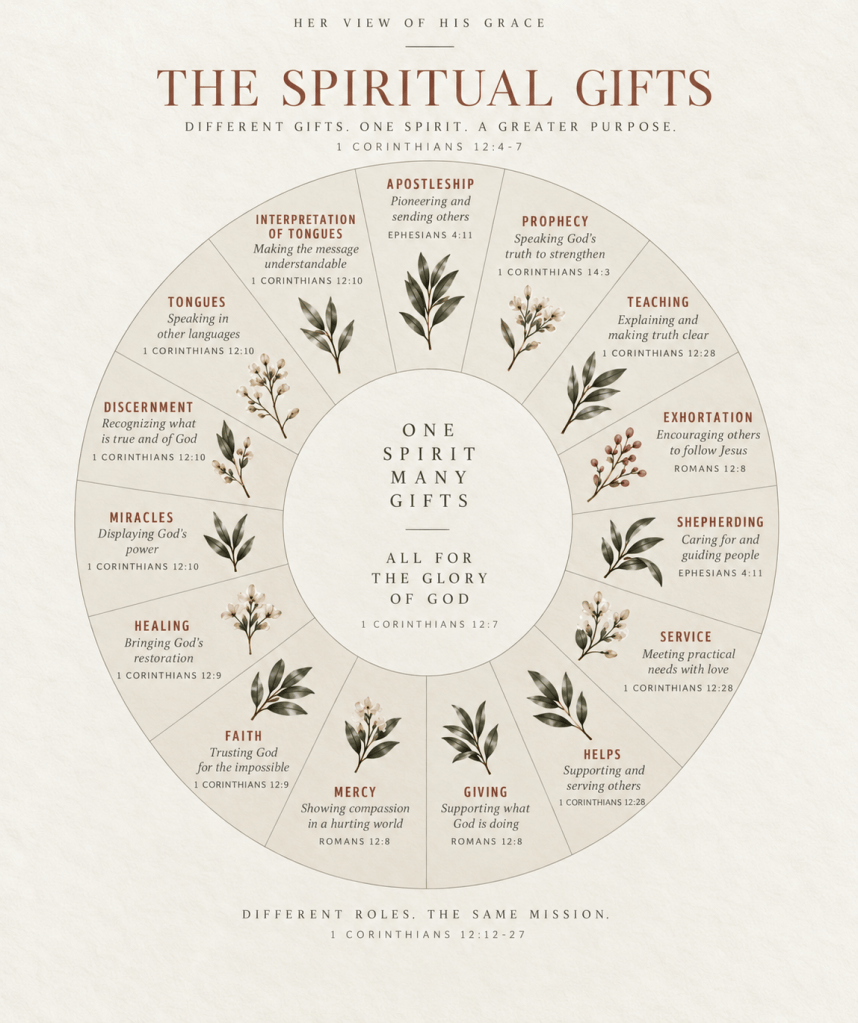
The Gifts of the Holy Spirit
This is probably the part of the conversation most of us have heard about. The New Testament teaches that the Holy Spirit gives gifts to believers for the good of the church.
Romans 12, 1 Corinthians 12, Ephesians 4, and 1 Peter 4 all discuss gifts or ministry roles. Depending on the passage, we see things like teaching, exhortation, mercy, giving, leadership, helps, faith, discernment, prophecy, healing, administration, evangelism, shepherding, and others.
What I find interesting is that Scripture does not give us one tidy master checklist. Paul’s main picture in 1 Corinthians 12 is the body.
A body has many parts, and those parts do different things. An eye does not need to become a hand. A hand does not need to compete with a foot. Different functions are necessary because the whole body needs them. Spiritual gifts work the same way. The Spirit gives gifts for the common good.
Your gift was never meant to make you impressive. It was meant to help you love and serve other people. So maybe the better question is not simply, What is my spiritual gift?
Maybe it is, How has the Spirit equipped me to build up the people around me?
What Christians Disagree About
This is one of those areas where Christians who deeply love Jesus and take Scripture seriously do not all reach the same conclusion.
Some Christians are cessationists. They believe certain miraculous gifts described in the New Testament served a particular purpose during the apostolic era and are not ordinarily given in the same way today.
Other Christians are continuationists. They believe the gifts of the Spirit described in the New Testament continue to operate in the church today.
There are faithful Christians on both sides of that discussion.
Wherever we land, Scripture gives us some important guardrails. The gifts come from God. The Spirit distributes them as He chooses. They are given for the good of others. They should build up the church. And everything should ultimately point people toward Jesus rather than drawing attention to the person exercising the gift.
Those are boundaries worth holding onto.
Something I Took From Forgotten God
Francis Chan’s Forgotten God challenged me because he asks a deeply uncomfortable question: Have we learned how to live Christianity without actually depending on the Holy Spirit?
We can plan well. We can organize. We can build systems. We can make responsible decisions. We can create ministry strategies and fill our calendars with good things. And it is possible to become so capable that we rarely have to ask whether we are actually depending on God. That thought has stayed with me.
Believing in the Holy Spirit on paper is one thing. Living as though I genuinely need Him is another. Do I ask Him to lead me? Do I respond when Scripture convicts me? Do I rely on His strength when obedience takes me beyond my own ability?
The Holy Spirit is how we actually live out the gospel in our lives.
Something Kay Arthur Helped Me Picture
Years ago, I remember watching Kay Arthur teach and use the simplest little object lesson to explain the Holy Spirit. She would use a glove and a white handkerchief or tissue. The glove represented us, and the handkerchief represented the Holy Spirit within the believer.
That picture stayed with me.
A glove can sit there looking perfectly fine, but on its own it cannot do anything. It needs something inside of it to give it movement and purpose. That is such a simple picture of the Christian life.
We can be disciplined, responsible, capable women and still completely miss what it means to depend on the Holy Spirit. God never intended for us to grit our teeth and try harder to live like Jesus in our own strength.
He gave us His Spirit.
The Spirit is the One who strengthens us to obey, helps us love when it is hard, gives us courage when we feel weak, and keeps forming the life of Jesus in us. That little illustration helped make one truth really clear for me: I am the vessel. He is the power within.
What I Want You to Remember
The Holy Spirit is not the strange part of Christianity that we leave for someone else to figure out. He is God with us and within us.
He points us toward Jesus, helps us understand truth, strengthens us in weakness, produces fruit in our lives, and equips us to serve the body of Christ. The Spirit takes truth we may already know in our heads and begins working it into our lives. He forms Christlike character, convicts us when something needs to change, equips us to serve, and empowers ordinary obedience.
Sometimes the evidence of the Spirit’s work is a supernatural gift.
Sometimes it is a woman who used to lose her temper choosing patience.
Sometimes it is forgiveness when bitterness would be easier.
Sometimes it is courage to say yes to something God has asked you to do.
Sometimes it is faithfulness in a season nobody else sees.
That is holy work too.
And if you are reading this while packing lunches, folding laundry, sitting in pickup line, answering emails, or moving through another very ordinary day, the Spirit of God is not waiting for you somewhere more spiritual. He is present right there. The question is whether we are learning to walk with Him.
Open Your Bible
If you want to go deeper, I would start with John 14:16 to 17 and 26, John 16:7 to 15, Acts 1:8, Acts 2:1 to 4, Romans 8:9 to 27, 1 Corinthians 6:19 to 20, 1 Corinthians 12, Galatians 5:16 to 25, Ephesians 4:1 to 16 and 30, and 1 Peter 4:10 to 11.
You do not need to read all of those in one sitting. Choose one passage, open your Bible, and pay attention to what it teaches you about who the Holy Spirit is and what He does.
Sources & Further Study
This Study Room article was developed primarily through Scripture, with additional research and reflection from the following resources.
Rose Publishing. Rose Handbook of Bible Charts, Maps, and Timelines. Rose Publishing. The handbook includes reference material on the Holy Spirit, spiritual gifts, and the biblical passages in which those gifts appear.
Chan, Francis. Forgotten God: Reversing Our Tragic Neglect of the Holy Spirit. David C. Cook, 2009. Chan explores the church’s tendency to acknowledge the Holy Spirit theologically while sometimes living with very little practical dependence on Him.
Arthur, Kay. Ephesians: The Mystery of God’s Church, Our Identity, Our Walk, Our Warfare. Precepts for Life, Precept Ministries International. This study has deeply influenced my understanding of the Holy Spirit’s indwelling presence, filling, and power in the believer’s everyday life.


Leave a Reply