
I want to take you to Ephesians 6 for a minute.
10 Finally, be strong in the Lord and in his mighty power. 11 Put on the full armor of God, so that you can take your stand against the devil’s schemes. 12 For our struggle is not against flesh and blood, but against the rulers, against the authorities, against the powers of this dark world and against the spiritual forces of evil in the heavenly realms. 13 Therefore put on the full armor of God, so that when the day of evil comes, you may be able to stand your ground, and after you have done everything, to stand. 14 Stand firm then, with the belt of truth buckled around your waist, with the breastplate of righteousness in place, 15 and with your feet fitted with the readiness that comes from the gospel of peace. 16 In addition to all this, take up the shield of faith, with which you can extinguish all the flaming arrows of the evil one. 17 Take the helmet of salvation and the sword of the Spirit, which is the word of God.
Paul tells believers to put on the whole armor of God so that we can stand firm against the schemes of the devil. He describes the belt of truth, the breastplate of righteousness, the shoes of gospel readiness, the shield of faith, and the helmet of salvation. Then, in verse 17, he tells us to take up the sword of the Spirit, which is the Word of God. 18 And pray in the Spirit on all occasions with all kinds of prayers and requests. With this in mind, be alert and always keep on praying for all the Lord’s people. 19 Pray also for me, that whenever I speak, words may be given me so that I will fearlessly make known the mystery of the gospel, 20 for which I am an ambassador in chains. Pray that I may declare it fearlessly, as I should.
Have you ever noticed that the sword is the only offensive weapon in the armor Paul describes?
God has given us His Word to help us stand against the enemy, recognize deception, and remain grounded in truth. But Scripture does so much more. It reveals God’s character, exposes the sin in our hearts, corrects our thinking, and teaches us how to live in obedience to Him. In John 17:17, Jesus prays that His followers would be sanctified in the truth. And in Hebrews 4:12, we learn that God’s Word is living and active, discerning the thoughts and intentions of the heart.
If we want to grow in holiness, recognize false teaching, and make disciples, we need to know the Word of God.
And Jesus Himself gives us an extraordinary example of why.
Even Satan Quoted Scripture
In Matthew 4:1–11, Jesus is led by the Spirit into the wilderness, where He fasts for forty days and is tempted by the devil.
Consider how Jesus responds to each temptation.
Matthew 4:3–4 | The temptation to turn stones into bread
Satan challenges Jesus to prove He is the Son of God by turning stones into bread. Jesus responds by quoting Deuteronomy 8:3, reminding him that man lives by every word that comes from God’s mouth. Jesus refuses to satisfy His hunger by acting independently of His Father’s will.
Matthew 4:5–7 | The temptation to test God’s protection
This time Satan quotes Scripture himself! He uses Psalm 91:11–12 to suggest that Jesus should throw Himself from the temple because God has promised angelic protection.
And how does Jesus respond?
“Again it is written” (Matthew 4:7, ESV).
He answers with Deuteronomy 6:16, showing that God’s promise of protection does not give us permission to put Him to the test.
Don’t miss that. Satan knew Scripture well enough to quote it, but he used it to encourage disobedience.
Matthew 4:8–10 | The temptation to worship Satan
Finally, Satan offers Jesus the kingdoms of the world in exchange for worship. Jesus again answers from Scripture, quoting Deuteronomy 6:13 and affirming that worship and service belong to God alone.
Three temptations. Three responses grounded in God’s Word.
Now, Jesus is the sinless Son of God, and His victory is far greater than an example for us to imitate. But His responses demonstrate something we desperately need to understand: knowing isolated Bible verses is not the same as understanding Scripture faithfully.
Even the enemy can quote a verse. The question is whether we understand what God has actually said.
How Much Do We Really Know?
Now, let me ask you something.
You might be able to tell me what’s happening in Washington this week, what your favorite influencer just shared, which new product everyone is buying at Target, or every detail of the latest true crime documentary.
But what if I asked you who Israel’s first king was? Could you name the four Gospels? Could you explain how the Old and New Testaments fit together?
I’m asking myself these questions too.
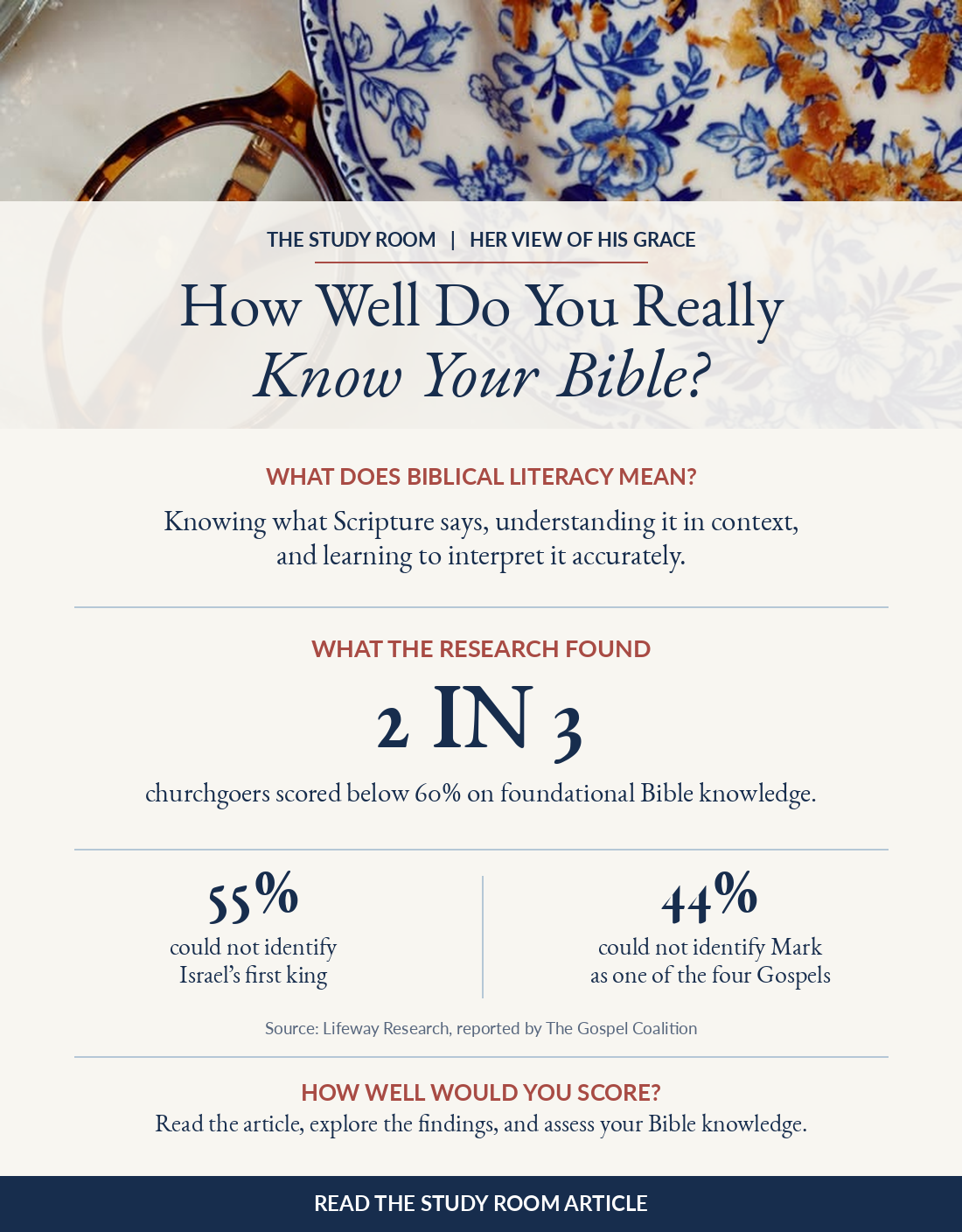
On November 3, The Gospel Coalition published an article examining recent Lifeway Research on biblical literacy among more than 2,000 churchgoing Christians.
The findings should get our attention. Two out of three participants scored below 60% on foundational Bible knowledge. 55% couldn’t identify Israel’s first king, and 44% couldn’t identify Mark as one of the four Gospels. And these were people who attended church regularly. I think we need to let that sink in.
We can spend hours consuming information about practically anything that interests us, while struggling to find time to study the very Word God has given us for life and godliness.
Why Biblical Literacy Matters
Biblical literacy is the ability to know, understand, and accurately interpret Scripture. It means understanding what the Bible says, what it means in context, and how we should faithfully respond to it.
Paul tells us in 2 Timothy 3:16–17 that Scripture is God-breathed and useful for teaching, rebuking, correcting, and training us in righteousness. God’s Word is essential to our spiritual growth.
And there’s a reason Paul describes spiritual immaturity using the illustration of milk in 1 Corinthians 3:1–3. The Corinthians were still behaving in ways that reflected their immaturity. In Hebrews 5:12–14, the writer similarly calls believers toward maturity, describing those who have developed discernment through practice. We should want to grow beyond spiritual infancy.
How can we faithfully contend for the faith, as Jude 3 instructs us, if we don’t understand what we believe? How can we make disciples, as Jesus commands in Matthew 28:18–20, if we’re not growing as disciples ourselves?
And how can we recognize the enemy’s distortion of Scripture if we rarely open our Bibles?
I wonder how many of us are longing for greater spiritual maturity while neglecting one of the primary means God has given us to grow.
Are You Brave Enough?
Lifeway Research has provided a 25-question biblical literacy quiz, and I want to challenge you to take it. It takes just a few minutes.
No cheating! 😉
And please hear my heart. This is not an invitation to shame yourself over what you don’t know. Your score cannot measure your love for Jesus, your salvation, or the work of the Holy Spirit in your life.
This is an opportunity to recognize where you are and consider where you might need to grow. Maybe you’ll discover you know more than you thought. Maybe you’ll realize there are entire portions of Scripture you’ve never studied. Either way, what a wonderful opportunity to begin learning!
That’s why The Study Room exists. I want us to become women who can open God’s Word, understand it in context, recognize truth, and faithfully share it to the people God has placed in our lives. You don’t need to know everything today. You just need to be willing to keep learning. One faithful step after another. One Scripture after another.
No shame. Just a gracious invitation to grow in the knowledge of the God who already knows you.
Take the 25-question Bible Literacy Quiz
The Study Room Glossary
Biblical Literacy: The ability to know, understand, and accurately interpret Scripture, including its historical context, central teachings, and overarching message.
Sanctification: God’s ongoing work of making believers holy and increasingly like Christ through the Holy Spirit.
Discernment: The Spirit-enabled ability to recognize and distinguish truth from error, and good from evil, in accordance with God’s Word.
Hermeneutics: The principles and methods used to interpret Scripture faithfully, considering its language, historical setting, literary context, and place within the whole Bible.
Discipleship: Following Jesus, growing in faith and obedience, and helping others learn to follow Him.
Scripture for Further Study
Ephesians 6:10–18 | The armor of God
Matthew 4:1–11 | Jesus’ temptation in the wilderness
Deuteronomy 8:3; 6:13, 16 | Jesus’ responses to Satan
John 17:17 | Sanctification through truth
Hebrews 4:12 | The living and active Word of God
2 Timothy 3:16–17 | Scripture equips believers
1 Corinthians 3:1–3; Hebrews 5:12–14 | Spiritual immaturity and maturity
Jude 3 | Contending for the faith
Matthew 28:18–20 | Making disciples
Sources and Further Reading
Jen Wilkin, The Gospel Coalition (November 3, 2026). Your Church May Know Less Bible Than You Think (And What to Do About It).
Lifeway Research. Bible Literacy Quiz.
Ephesians 6:10–20 is quoted from the New International Version (NIV). Matthew 4:7 is quoted from the English Standard Version (ESV).


Leave a Reply