
What does it mean that God is holy?

Pour a little oil into a glass of water and watch what happens.
For a moment, the oil may break into tiny droplets and move throughout the glass, but give it a little time and the separation becomes obvious. The oil does not become the water, and the water does not become the oil. They remain distinct.
This simple illustration to help us begin thinking about holiness. Holiness carries the idea of being separate, set apart, and devoted to God. But when we say that God is holy, we are saying something even bigger.
We sing the word. We read it in our Bibles. We call Scripture the Holy Bible. We talk about the Holy Spirit. Maybe you have even sung “Holy, Holy, Holy” since you were a little girl. But if someone stopped you and asked, “What does holy actually mean?” could you explain it?
Let’s go a little deeper.
First, What Is an Attribute of God?
An attribute of God is simply a characteristic that is true of who God is. God is not occasionally holy. He is holy. He is not sometimes faithful, sometimes good, or loving only when He feels like it. These attributes describe His very nature.
Theologians sometimes divide God’s attributes into two categories: communicable and incommunicable. I know. Big Bible words. Stay with me. Incommunicable attributes are characteristics that belong uniquely to God. God is eternal, infinite, and omnipresent. You and I will never become those things. Communicable attributes are characteristics of God that human beings can reflect in a limited way because we were created in His image. We can love because God is loving. We can show mercy because God is merciful. We can pursue goodness because God is good.
Holiness is often placed in that second category because Scripture actually calls God’s people to be holy. We will never possess holiness in the way God does. He is the source and standard of holiness. But His people are called to reflect His character.
So, What Does Holy Mean?
The basic idea behind holiness is separation. Something holy is set apart from what is common and devoted to God.
We see this throughout the Old Testament. The tabernacle was holy. Certain objects were holy. Priests were consecrated for holy service. The Sabbath was made holy. There were holy ceremonies and holy places. Those things were holy because they belonged to God and were set apart for His purposes.
God’s holiness goes much deeper than that. God is completely separate from sin and evil. There is no corruption in Him, no darkness, no moral defect. He is perfectly pure. His holiness also speaks to His absolute uniqueness. There is no one like Him. He is Creator, and we are created. He is infinite, and we are finite. He is completely worthy of worship, devotion, and obedience.
God is not simply a better version of us. He is God.
“Holy, Holy, Holy”
Isaiah looks, and there He is. The Lord, high and exalted, seated on a throne. The train of His robe stretches through the temple until it fills it. Above the throne, seraphim are flying. Six wings each. With two they cover their faces before Him. With two they cover their feet. With two they fly.
And then they were calling out to each other.
“HOLY, HOLY, HOLY IS THE LORD ALMIGHTY!”
“THE WHOLE EARTH IS FULL OF HIS GLORY!”
Back and forth they call to one another, declaring the holiness of the One seated on the throne.
And their voices shook the room.
The doorposts tremble. The thresholds shake. The temple begins to fill with smoke. Isaiah is standing before the King while the throne room around him is shaking with the sound of heavenly beings declaring one thing over and over:
Holy. Holy. Holy.
And Isaiah comes undone.
“Woe to me!” he cries. “I am ruined!”
Standing in the presence of perfect holiness, Isaiah suddenly sees his own uncleanness. “I am a man of unclean lips, and I live among a people of unclean lips.” He has seen the King, the LORD Almighty, and there is nowhere for his sin to hide.
Then, through the smoke, one of the seraphim moves toward the altar. He takes a live coal with tongs and flies to Isaiah. The coal touches Isaiah’s lips, the very place he has just confessed as unclean.
And then come the words:
“See, this has touched your lips; your guilt is taken away and your sin atoned for.”
Can you feel the weight of this scene?
The throne. The seraphim. Their voices calling to one another. The shaking doorposts. The trembling thresholds. The smoke filling the temple. Isaiah realizing exactly who is before him and exactly who he is before Him.
This is holiness.
And yet, right there in the presence of a holy God, we also see something else.
God makes provision for an unclean man to be made clean.

“Holy, holy, holy is the LORD Almighty; the whole earth is full of his glory.” Isaiah 6:3
In Hebrew, repetition gives emphasis, so calling God “holy, holy, holy” magnifies the declaration. This is not a casual description. It is a proclamation of who He is.
And look at Isaiah’s response. He does not walk away thinking only about how beautiful the moment was. He becomes painfully aware of his own sin. He cries,
“Woe to me!… For I am a man of unclean lips.” Isaiah 6:5
Seeing God’s holiness changed the way Isaiah saw himself.
That helps us understand something we are going to see over and over throughout the Old Testament.
Why Holiness Matters When You Read Leviticus
This becomes especially important as we study the Feasts of the Lord. Leviticus can feel strange to modern readers because it is filled with sacrifices, priests, washings, clean and unclean distinctions, holy places, holy days, and detailed instructions about approaching God.
It can feel like an exhausting collection of religious rules until we understand one foundational truth: a holy God had chosen to dwell among sinful people.
That changes the way we read everything.
The laws surrounding Israel’s worship were not random hoops God made His people jump through. They taught Israel something about the God who lived among them. He is holy. Sin is serious. Approaching God is serious. Sinful people cannot make themselves holy enough to enter the presence of a holy God.
Suddenly the sacrifices begin to make more sense. The priesthood makes more sense. The Day of Atonement makes more sense. Even the feasts make more sense. God was teaching His people who He is and what it means to belong to Him.
“Be Holy, Because I Am Holy”
God told Israel, “Be holy because I, the LORD your God, am holy.”
Notice the reason. God does not tell His people to be holy so that He will love them. Their holiness is supposed to flow from His holiness. You belong to Me, therefore live like people who belong to Me.
And that command does not disappear when we reach the New Testament. Peter writes,
“But just as he who called you is holy, so be holy in all you do,”
and then reaches straight back into Leviticus with, “Be holy, because I am holy.” 1 Peter 1:15-16
God’s people are still called to holiness.
How Can Sinful People Come Near a Holy God?
This is one of the great questions running underneath the entire Bible. If God is perfectly holy and we are sinful, how can we ever be in relationship with Him?
The Old Testament sacrificial system showed both the seriousness of that problem and God’s gracious provision for His people. But those sacrifices were never the end of the story. They pointed beyond themselves.
Jesus came. He lived the holy life we could not live, offered Himself for sinners, and made a way for sinful people to come near to a holy God.
Hebrews says,
“For by one sacrifice he has made perfect forever those who are being made holy.” Hebrews 10:14
That phrase matters: those who are being made holy.
The gospel does not lower God’s standard of holiness so we can finally reach Him. God makes a way for sinners to come near through Christ, and then He begins changing us.
Holiness Is More Than “Being Good”
This is where holiness can easily become misunderstood. We can reduce it to a Christian behavior checklist: do not do this, do not watch that, do not say that, dress this way, avoid those people.
Biblical holiness is deeper than that.
To be holy is to belong to God.
Because we belong to Him, there will absolutely be things we leave behind. Sin and holiness do not comfortably coexist. God changes our desires, our decisions, our relationships, our words, and the way we live. But holiness is not about creating an impressive Christian exterior. It is about becoming increasingly devoted to the One who has called us His own.
The theological word for that process is sanctification. God saves us, sets us apart as His people, and through the work of the Holy Spirit increasingly conforms us to the image of Christ.
We are not earning our place with Him. We are learning to live like women who already belong to Him.
Go Back to the Glass
Think again about that oil and water. There is distinction. Separation. Something visibly different.
That little illustration is not large enough to capture the holiness of God. No illustration could. But maybe it gives us somewhere to begin.
God is holy. There is no darkness in Him, no corruption, no impurity, no sin. And this holy God has called a people to Himself.
So when you encounter holiness throughout the Feasts of the Lord, when you read about a holy convocation, a holy place, a holy priesthood, or something being consecrated to the Lord, do not skim past the word.
Pay attention.
God was teaching His people something about Himself and something about them.
You belong to Me.
And He is still teaching His people what it looks like to live like we do.
Key Terms
| Term | What It Means |
|---|---|
| Attribute | A characteristic that is true of who God is. |
| Communicable Attribute | An attribute of God that humans can reflect in a limited way because we are made in His image. |
| Incommunicable Attribute | An attribute that belongs uniquely to God and is not shared by created beings in the same way. |
| Holy / Holiness | God’s perfect purity and His complete distinction from sin and creation. When used of God’s people or things devoted to Him, it carries the idea of being set apart for God. |
| Consecrate | To dedicate or set apart a person, place, or thing for God’s purposes. |
| Sanctify | To make holy or set apart as holy. |
| Sanctification | God’s ongoing work in believers by which they increasingly grow in holiness and Christlikeness. |
| Sacred | Set apart or devoted to God rather than ordinary use. |
| Profane / Common | In biblical holiness language, something ordinary or common rather than set apart as holy. It does not always mean sinful or vulgar. |
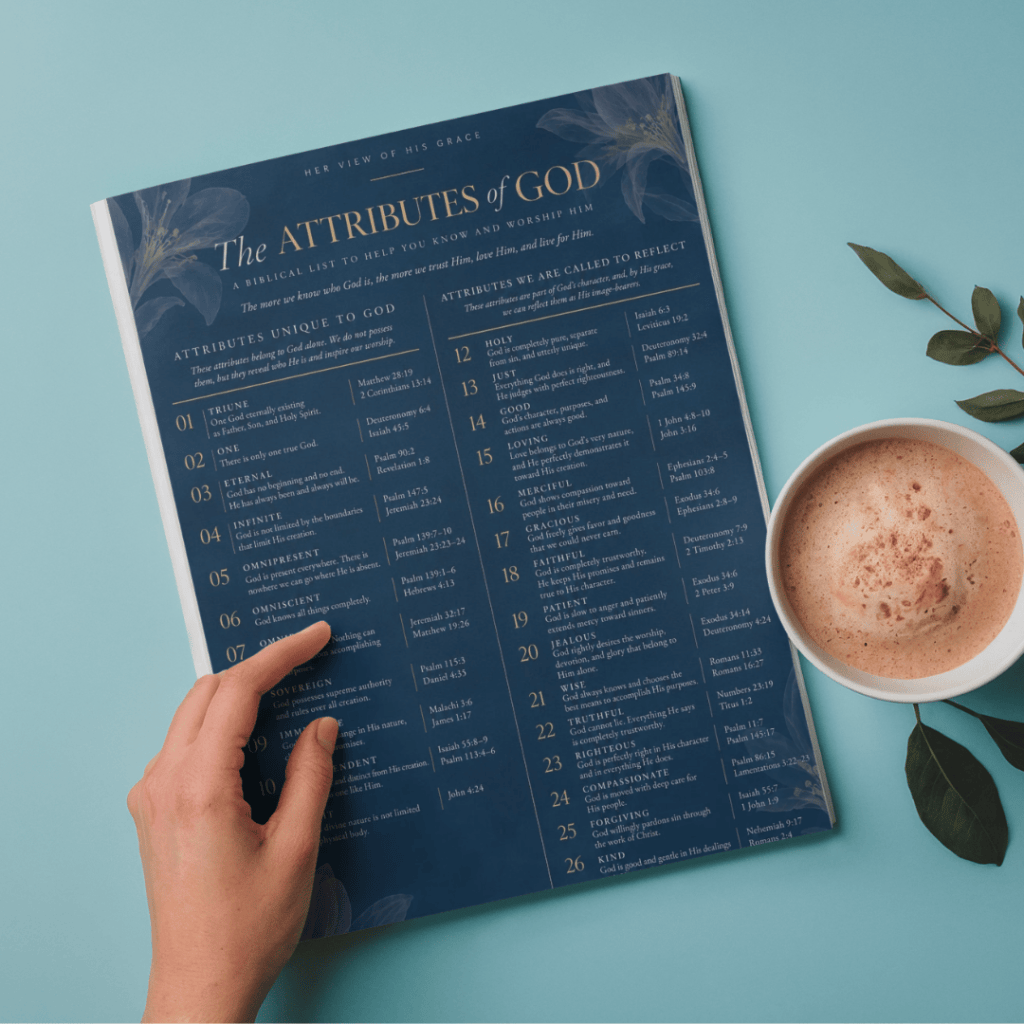
Want to keep going? Download the free Attributes of God Reference Guide from The Reset Room, with 26 attributes, simple definitions, and Scriptures to help you know the God you worship.
Sources & Further Study
Grudem, Wayne. Systematic Theology: An Introduction to Biblical Doctrine. Zondervan Academic. See the chapters on the communicable attributes of God, particularly Grudem’s discussion of holiness. Grudem defines God’s holiness in terms of His separation from sin and devotion to His own honor, while also explaining holiness as both moral purity and being set apart for God.
Rose Publishing. Rose Handbook of Bible Charts, Maps, and Timelines. Rose Publishing, 2024. See “Attributes of God,” pp. 400–407. This is the source for the oil and water illustration used to introduce holiness, as well as the framework distinguishing communicable and incommunicable attributes.
Spangler, Ann. Praying the Attributes of God: A Guide to Personal Worship Through Prayer. Zondervan. Spangler approaches the attributes devotionally, helping readers move from understanding who God is to responding to His character in prayer and worship.
Primary biblical passages: Isaiah 6:1–7; Leviticus 10:10; 11:44–45; 19:2; 20:26; Psalm 99:3–9; Exodus 19:4–6; 1 Peter 1:15–16; Hebrews 10:10–14; 12:10–14; Ephesians 5:25–27.


Leave a Reply