
Main Theme
Resurrection and harvest.
Today’s Truth
Firstfruits points to Jesus’ resurrection, and Pentecost points to the Spirit-filled harvest that followed. God asks for the first because He is Lord of the whole, and He gives His Spirit so the harvest can go out.
Scripture Reading
This week’s Scripture reading comes from Leviticus 23:9 to 22, Deuteronomy 26:1 to 11, Acts 2, and 1 Corinthians 15:20 to 23.
Supporting Scripture
We will also look at Romans 8:23, James 1:18, and Galatians 5:16 to 25.
A Feast That Teaches Us to Trust Before Fullness
Last week, we began with Passover and Unleavened Bread. We saw the blood that saves and the life that follows. We saw how God rescues His people and then lovingly teaches them what cannot come with them. This week, we keep moving through the story of redemption with Firstfruits and Pentecost.
At first, these feasts may feel less familiar than Passover. Most of us are not walking into fields, cutting sheaves of grain, and bringing the first portion to the priest. We are more familiar with grocery pickup, school schedules, packed lunches, car lines, and coffee before anyone asks us a question. But the invitation beneath these feasts still reaches into our ordinary lives.
Firstfruits asks a question every woman eventually has to answer: do I trust God with the first before I can see the full?
Firstfruits was not an offering brought after everything had been gathered, counted, stored, and secured. It was the first portion of the harvest brought before the Lord while the rest of the harvest was still standing in the field. Before Israel enjoyed the fullness, they brought the first. Before they knew exactly how much would come in, they worshiped the One who gave it.
The first belongs to God because the whole harvest belongs to God.
Firstfruits is trust before fullness.
Firstfruits: The First Belongs to God
In Leviticus 23:9 to 14, the Lord instructed Israel to bring the first sheaf of the harvest to the priest. The priest would wave it before the Lord, and this offering marked the beginning of the harvest season. It was tied to the land, the provision of God, and the promise He had kept.
Israel had been enslaved in Egypt. They had wandered in the wilderness. They had depended on manna day after day. Now, as they entered the land God promised, the harvest became a visible reminder that God had brought them out, carried them through, and brought them in.
They did not bring the firstfruits because God was needy. They brought the firstfruits because they were confessing the truth. The land was His. The harvest was His. The provision came from His hand.
Deuteronomy 26:1 to 11 gives another beautiful picture of this. When the people brought the first produce from the land, they were to place it in a basket, bring it before the Lord, and remember their story. They remembered their affliction, their deliverance, and the land God had given. They were not just bringing produce. They were bringing worship wrapped in remembrance.
Israel may have thought the promise was mainly the land, and the land really was a promise. It was provision, inheritance, stability, and proof that God had not forgotten what He said. But the promise was always bigger than a place. God was moving the story toward His Son. He was giving us Jesus, the true and better promise, the One who would rescue us from sin, defeat death, rise from the grave, and give eternal life to all who belong to Him.
That is why we have to read Firstfruits through the fullness of the gospel. Under the old covenant, these offerings were part of Israel’s worship and obedience before the Lord. But we live on this side of the cross. We are not bringing God our first to earn acceptance, and we are not required to bring special offerings in order to be made right with Him.
Jesus is the ultimate offering.
Because of the gospel, we do not give from fear. We give from belonging. We do not bring God our best so He will accept us. We bring Him our best because, in Christ, we already are accepted.
That means the heart behind Firstfruits matters even more than the thing we bring. God is not after a prettier basket, a more impressive gift, or a perfectly polished offering. He is after a heart that remembers who gave the harvest in the first place.
And this gets personal fast, because we all know what it is to give God what is left. Leftover attention. Leftover energy. Leftover obedience. Leftover trust after we have already tried to manage everything ourselves. But Firstfruits invites us into a different posture.
It invites us to bring Him the first.
The first minutes of the morning. The first response before our schedules take over. The first portion of our income. The first word before we vent. The first thought before worry builds a whole house in our minds.
This does not mean every morning will look quiet, peaceful, and candlelit. Some mornings begin with a child needing you, a dog barking, a message waiting, laundry that never got moved, and a mind already running before your feet hit the floor. But the heart of Firstfruits still applies. God is worthy of first place, not because He is keeping score, but because the first reveals trust.
We understand this more than we think we do. At a birthday party, the first piece of cake belongs to the birthday boy or girl. It would feel strange to cut the cake and serve everyone else first while the one being celebrated stands there waiting. The first piece is a way of saying, “This is about you.”
In the same way, bringing the first to God is a way of saying, “This life is about You. This provision is from You. This day belongs to You. This harvest is Yours.”
Jesus: The Firstfruits of Resurrection
Firstfruits does not only teach us about trust. It also points us to Jesus.
In 1 Corinthians 15:20 to 23, Paul calls Christ the firstfruits of those who have fallen asleep. That word is not accidental. Paul is showing us that Jesus’ resurrection is the beginning of the resurrection harvest God promised. His empty tomb is the guarantee that more resurrection is coming.
When Jesus walked out of the tomb, He did not merely survive death. He defeated it. He rose as the firstfruits of everyone who belongs to Him, the living promise that one day, all who are in Christ will rise with Him.
That means our hope is not vague. It is anchored in an empty tomb. Because Jesus lives, those who belong to Him will live too. Because He was raised, we will be raised. Because He has risen, the fullness is coming.
This changes how we grieve, how we suffer, how we wait, and how we face what is still unfinished. Death does not get the final word over those who are in Christ.
Jesus’ resurrection was the first sheaf of a greater harvest.
Every believer lives in the middle of what Jesus has already done and what He has not yet fully finished. Jesus has already risen from the dead, so we know resurrection is coming for everyone who belongs to Him. We have already been given the Holy Spirit, so we have a taste of what is coming. But we are not living in the fullness yet.
That is why we can have real hope and still feel tired. We can believe God’s promises and still walk through pain. We can have new life in Christ and still ache for the day when everything broken is finally made whole.
Romans 8:23 reminds us that the Spirit is like the first part of the harvest. He is the promise that more is coming. So when life feels unfinished, we do not have to wonder if God forgot.
We have seen the first. And we can trust Him for the full.
That is why Firstfruits speaks so tenderly to women who are waiting. Maybe you can see a little growth, but not the whole answer. A little healing, but not the full restoration. A little obedience, but not the fruit you prayed for. A little change in your child, your marriage, your heart, your calling, or your home, but not yet the fullness.
Firstfruits says, “Bring God the first. Trust Him with the rest.”
Because the God who gave the first is faithful over the whole harvest.
The Spring Feasts, Holy Week, and Pentecost
Before we move into Pentecost, it helps to step back and see how closely the spring feasts sit beside Holy Week.
Jesus died at Passover, the feast that remembered rescue by the blood of the lamb. He was buried during Unleavened Bread, the feast connected to bread without leaven and the call to holiness. He rose as the firstfruits of resurrection. Then, fifty days later, on the Feast of Weeks, also called Pentecost, the Holy Spirit was poured out.
This is one of the reasons the feasts matter. They help us see that the Old Testament was always pointing forward to Jesus, and the New Testament keeps showing us how Jesus fulfills what God had been revealing all along.
God was telling one story.
The Lamb would be slain. The grave would be emptied. The Spirit would be given. And the gospel harvest would begin to go out.
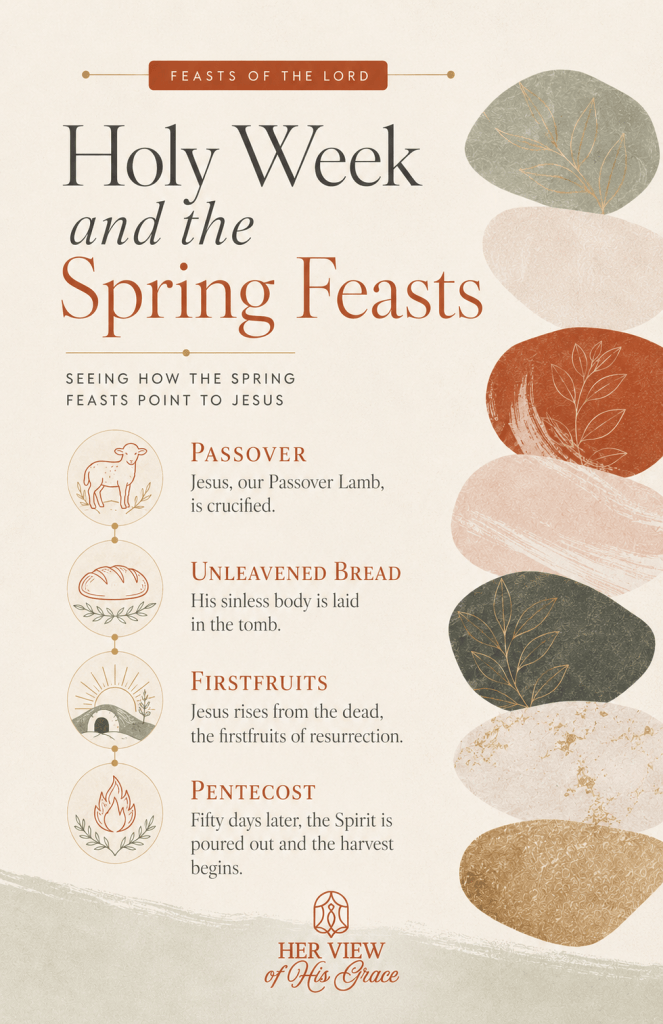
The feasts are not the gospel themselves, but they help us see the gospel more clearly. They show us that God’s redemption story was never random. From rescue to resurrection, from the gift of the Spirit to the promise of Christ’s return, God has always been moving His people toward Jesus.
Pentecost: The Harvest Goes Out
Fifty days after Firstfruits came the Feast of Weeks, also known in the New Testament as Pentecost. In Leviticus 23:15 to 22, God told His people to count seven full weeks from the day after the Sabbath, from the day they brought the sheaf of the wave offering. On the fiftieth day, they were to bring a new grain offering to the Lord.
That is where the word Pentecost comes from. It means fiftieth in Greek.
Before Pentecost was an Acts 2 word, it was an Old Testament feast. It was a feast that taught God’s people to count the weeks, bring the harvest before Him, gather in worship, and remember that every bit of provision came from His hand. They were not only counting days. They were learning to wait, remember, worship, and trust.
And this is one of the reasons studying the feasts matters so much. It helps us see how the Old Testament points forward to Jesus, and how the New Testament keeps pointing us back to Jesus. The language may feel foreign at first, but once we begin to see the thread, the story becomes less confusing and more beautiful. God was not telling separate stories. He was telling one story of redemption.
So let’s move from Leviticus to Acts.
In Acts 2, the disciples were gathered in Jerusalem when the day of Pentecost came. The city would have been full of worshipers because Pentecost, the Feast of Weeks, was one of Israel’s appointed feasts. Jesus had died, risen, and ascended. The disciples had seen the risen Christ. They had heard His commission. But they were told to wait for the gift the Father had promised.
And on Pentecost, the Holy Spirit came.
That is breathtaking when we remember the feast underneath the moment. A feast connected to harvest became the day the Spirit was poured out and the harvest of the gospel began to go out to the nations.
The Holy Spirit came so the gospel could go farther.
And I do not want us to miss the waiting. God’s people had to wait between the promise and the gift. The disciples were not sent out in their own strength. They were filled before they were sent.
That matters for us because we are still living in a waiting season too. We live after the resurrection and after Pentecost, but before the return of Jesus. In a sense, we are still counting the weeks. We are still waiting for the fullness of what God has promised.
And while we wait, the Spirit forms fruit in us.
Galatians 5 shows us the difference between the works of the flesh and the fruit of the Spirit. Without the Holy Spirit, we naturally drift toward the flesh. We drift toward control, impatience, anger, jealousy, selfishness, comparison, fear, and striving. But when the Spirit is at work in us, His fruit begins to hang from our hearts and homes.
Love begins to show up where irritation used to lead. Joy grows in places that do not make sense on paper. Peace steadies us when the circumstances are still unsettled. Patience softens our responses. Kindness changes the tone of a room. Faithfulness keeps showing up in ordinary obedience.
That is Pentecost in real life.
The Spirit was not given only for a powerful moment in Jerusalem. He was given so the gospel would go out and so God’s people would be formed into the likeness of Christ as we wait for Him to return.
Pentecost reminds us that God does not only call His people. He fills His people. He does not send us empty. He does not ask weary women to muscle their way into holy fruit. He gives His Spirit.
The Spirit empowers witness, forms holiness, strengthens obedience, brings conviction, gives courage, and makes Jesus known.
The harvest goes out because God keeps His promise and fills His people with His presence.
The God Who Keeps His Promise
When you hold Firstfruits and Pentecost together, you begin to see the faithfulness of God from another angle. Firstfruits points to resurrection. Pentecost points to Spirit-filled mission. Firstfruits reminds us that Jesus is risen. Pentecost reminds us that His Spirit has come.
And both feasts remind us that God keeps His promise.
He kept His promise to Israel. He brought them out of Egypt, through the wilderness, and into the land. He kept His promise in Jesus. The Lamb was slain, the grave was emptied, and the firstfruits of resurrection were raised. He kept His promise at Pentecost. The Spirit came, the gospel went out, and the harvest began.
This is such a needed word for us because we often live in the middle of things. We live between prayer and answer, obedience and visible fruit, surrender and understanding, the first sheaf and the full harvest.
That middle place can make us impatient. It can make us controlling. It can make us wonder if small beginnings matter. It can make us hold back the first because we are afraid there will not be enough.
But Firstfruits and Pentecost call us back to trust. God is Lord of the harvest. God is faithful with the beginning. God gives His Spirit for what He calls us to do.
So maybe the question this week is not only, “What am I waiting for God to finish?” Maybe the better question is, “What first is He asking me to bring Him while I wait?”
Maybe it is the first few minutes of your morning before the phone gets your attention. Maybe it is the first portion of your provision before fear tells you to hold it tighter. Maybe it is the first response in a hard conversation before pride takes the lead. Maybe it is the first yes in obedience before you know where the whole road is going.
Firstfruits is trust before fullness.
Pentecost is power for the harvest.
For Real Life
For us, this does not stay in a field in ancient Israel, and it does not stay in an upper room in Acts 2. It comes right into the places where faith is lived.
It comes into the kitchen when we are tempted to begin the day with irritation instead of surrender. It comes into the budget when fear wants to decide what belongs to God. It comes into our schedules when we give Him the leftover scraps of attention and then wonder why our souls feel thin. It comes into our homes when we want the harvest of peace, patience, and wisdom, but keep planting hurry, control, and distraction.
Firstfruits asks whether God has first place or whatever is left after everything else has taken its share. That is not a shame question. It is a freedom question.
Because when God has the first, we remember that He is Lord of the whole. And when the Spirit fills us, we remember that we are not called to live fruitful lives in our own strength.
So this week, bring Him the first. Bring Him the beginning. Bring Him the small place of trust before the full answer is visible. Bring Him the first minutes, the first response, the first portion, the first step, the first yes.
Then trust Him with the harvest.
Reflection Questions
What does Firstfruits show us about God before it shows us anything about ourselves?
What stands out to you about God asking Israel to bring the firstfruits before the full harvest was gathered?
Where are you most tempted to give God what is left instead of what is first?
How does Jesus’ resurrection as the firstfruits strengthen your hope while you wait for fullness?
What changes when you remember that the Holy Spirit was given so the harvest could go out, not so you could strive harder?
What fruit of the Spirit do you most need the Lord to grow in your heart and home right now?
What first might God be asking you to bring Him this week?
Where might God be inviting you to rest because the whole harvest belongs to Him?
Reset Step
This week, choose one first to bring before the Lord. It may be the first few minutes of your morning, the first thought when worry rises, the first response in a tense conversation, the first portion of provision, or the first step of obedience you have been delaying.
Do not make it complicated. Make it sincere.
Before you reach for the phone, pause and pray. Before you respond in frustration, ask the Spirit to help you. Before you spend, remember who gave the harvest. Before you rehearse fear, bring the first thought to God.
Firstfruits is trust before fullness.
Ask the Lord to show you one small way to honor Him first, then trust Him with the harvest you cannot yet see. Then choose one place to rest from striving, not because the work does not matter, but because the harvest belongs to Him.
Closing Prayer
Lord, thank You for being the God who keeps His promise. Thank You for the faithfulness You showed Israel, the resurrection hope You gave us in Jesus, and the gift of the Holy Spirit poured out at Pentecost. Thank You that Jesus is the ultimate offering, and that we do not bring You our first to earn acceptance. In Christ, we already are accepted. Teach us to bring You the first because the whole harvest belongs to You. Forgive us for the ways we have offered You leftovers while trying to control the rest. Strengthen our trust when we cannot yet see the fullness. Fill us with Your Spirit so we do not strive in our own strength, but live as women sent with the hope of the gospel. Help us trust You with the first, the waiting, the resting, and the harvest. Amen.


Leave a comment