
A simple guide to how we got the Bible, why translations differ, and why Scripture can be trusted.
How did we get the Bible? Who decided what belonged in it? Why are there so many translations? Can I really trust that what I am reading today is faithful to what was written thousands of years ago?
Those are good questions.
If we are going to build our lives around Scripture, it is worth understanding where it came from, how it was preserved, and why we can trust the Bible we hold today.
That is part of why I wanted to create The Study Room.
I love devotionals, and sometimes a short word of encouragement is exactly what we need. But I also know there are women who want to go a little deeper. Women who want to understand their Bible better, know what they believe, and feel more confident when they open Scripture.
And I also know real life is loud.
You may be reading this while the dishwasher is running, someone is asking what is for dinner, the laundry is halfway finished, and your brain is holding twelve other things at once. You do not need three uninterrupted hours and a stack of commentaries to study more deeply.
You just need somewhere to start.
So let’s start with the book itself.
The Bible at a Glance
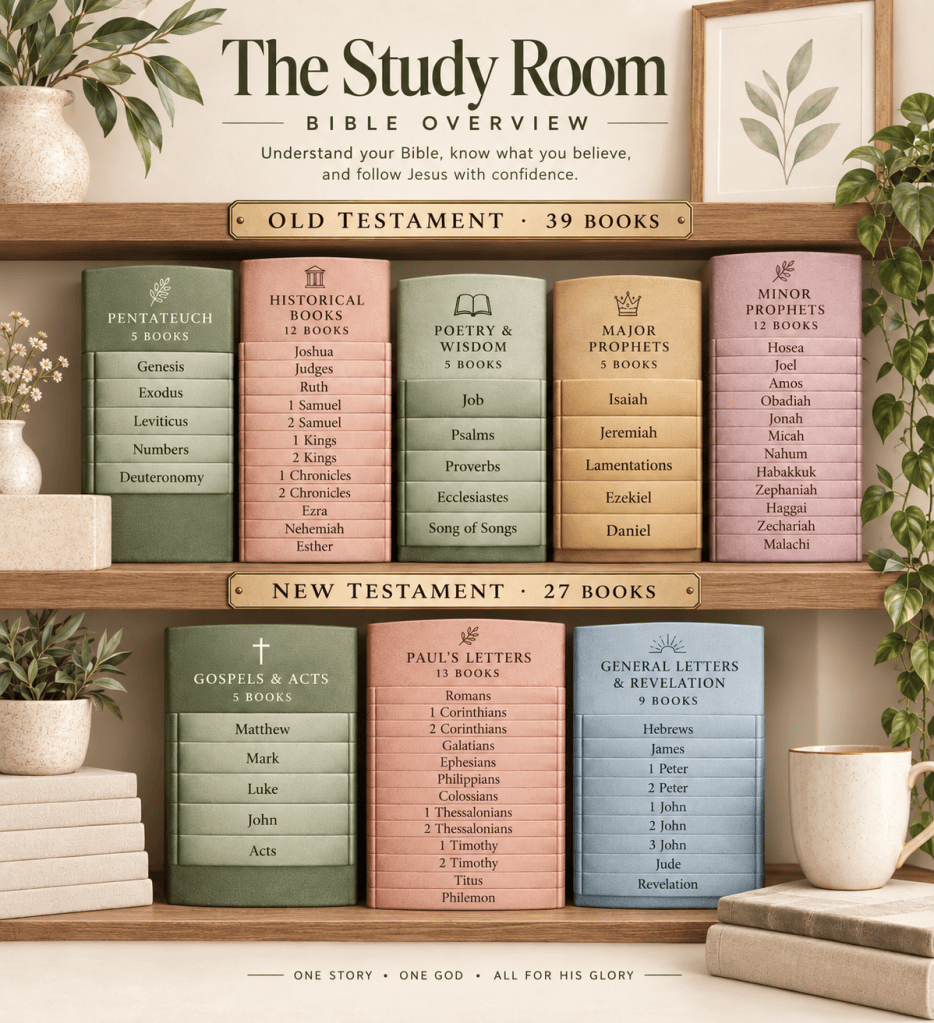
The Bible is made up of 66 books, but together they tell one unfolding story.
The Old Testament contains 39 books, and the New Testament contains 27 books.
The Old Testament begins with the Pentateuch, the first five books of the Bible: Genesis, Exodus, Leviticus, Numbers, and Deuteronomy. These books lay the foundation for creation, covenant, the story of Israel, and God’s law.
Then come the historical books, which trace the story of Israel through conquest, judges, kings, exile, and return. The poetry and wisdom books give us songs, prayers, questions, worship, grief, wisdom, and reflection. The prophets speak into Israel’s history, calling God’s people back to faithfulness and pointing forward to what God would ultimately do.
The New Testament opens with the Gospels, where Matthew, Mark, Luke, and John tell us about the life, ministry, death, and resurrection of Jesus. Acts shows the gospel beginning to spread through the early church. Then come letters written to churches and believers, many of them from Paul, followed by the general letters and Revelation.
You do not need to memorize all of those categories today. The point is simply to begin seeing the Bible as more than a random big book. There is structure, history, movement, and one larger story that ultimately leads us to Jesus.
How We Got the Bible
Here are ten things worth knowing.
1. The Bible is a collection of 66 books
The Bible is not one book written by one person at one time. It is a collection of 66 books written across many centuries by many different authors. Those writers included kings, prophets, leaders, fishermen, poets, historians, and apostles.
The Old Testament contains 39 books, and the New Testament contains 27.
2. It was written over a long stretch of history
The Old Testament was written over a very long period of time, beginnin years before Jesus was born and continuing through the centuries leading up to His birth. The New Testament was written much later, mostly between about AD 45 and AD 100, within the first century after Jesus.
Different scholars date some books differently, so do not get hung up on one exact year. The bigger point is that Scripture came together over a very long period of history.
3. The Bible was written in three main languages
The Old Testament was written primarily in Hebrew, with some portions written in Aramaic. The New Testament was written in Greek.
That important to know because every English Bible you read today is a translation from ancient languages.
4. Scripture is inspired by God
Second Timothy 3:16 says that all Scripture is “God breathed,” and 2 Peter 1:20 to 21 describes men speaking from God as they were carried along by the Holy Spirit.
The writers were real people with real personalities, cultures, experiences, and circumstances, but Christians believe God worked through them to communicate what He intended.
That is what we mean when we say Scripture is inspired.
5. The books were recognized over time
The Bible did not appear overnight as a finished 66 book collection.
The Old Testament Scriptures were preserved and received within the Jewish community. The New Testament writings circulated among early Christian churches and were recognized over time as authoritative.
The word for the recognized collection of biblical books is canon.
Church councils later affirmed collections Christians were already receiving and using as Scripture. The history is more gradual than the idea that one group sat down one day and simply decided which books made the cut.
6. Scripture was copied by hand for centuries
Before printing presses existed, copies of Scripture had to be made by hand.
Scribes copied biblical texts carefully and often used detailed methods for checking their work. Because humans were doing the copying, manuscript differences do exist. Some involve spelling, word order, or small wording differences.
Scholars compare surviving manuscripts to study where those variations occurred and determine the earliest wording of the text.
7. We have a large amount of manuscript evidence
Thousands of Greek New Testament manuscripts survive, along with ancient translations and quotations from early Christian writers.
That gives scholars a large body of evidence to compare.
The significance is not that every manuscript is identical in every tiny detail. The significance is that scholars are not depending on one isolated copy. They can compare many manuscripts and study how the text was transmitted over time.
8. The Dead Sea Scrolls gave us much older Old Testament manuscripts

The Dead Sea Scrolls were discovered beginning in 1947 in caves near the Dead Sea.
Among them were biblical manuscripts that were many centuries older than some of the Hebrew manuscripts scholars had previously been using. One of the most famous discoveries was a nearly complete scroll of Isaiah.
When scholars compared these manuscripts, they found remarkable continuity across centuries of transmission, along with the kinds of spelling and textual differences you would expect in handwritten copies.
The Dead Sea Scrolls did not remove every question, but they gave scholars valuable evidence about how carefully the Old Testament text had been preserved.
9. The printing press changed everything
For most of history, making another Bible required handwritten copying.
Then the printing press changed everything.
Around AD 1455, Johannes Gutenberg produced what became known as the Gutenberg Bible. It changed how quickly and widely copies could be produced and distributed.
10. Translation brought Scripture into everyday language
As Christianity spread, Scripture was translated into more and more languages.
By the time of the Protestant Reformation, translators such as Martin Luther and William Tyndale became especially important in making Scripture available in the languages ordinary people actually spoke.
That movement continues today.
The Timeline at a Glance
c. 1500 to 400 BC
Much of the Old Testament is written and collected. Exact dates vary by book.
c. 500 to 200 BC
The Hebrew Scriptures continue to be copied and transmitted. The Septuagint, an ancient Greek translation of the Hebrew Scriptures, begins to appear during this broader period.
c. 200 BC to AD 100
Manuscripts later associated with the Dead Sea Scrolls are copied and preserved.
c. AD 45 to 100
The New Testament books are written.
AD 100 to 300
New Testament writings circulate widely among churches. Early Christian writers quote them, copy them, and discuss which books carry apostolic authority.
AD 300s
Church leaders increasingly publish lists corresponding closely to the New Testament canon Christians recognize today. Athanasius gives a well known list of all 27 New Testament books in AD 367.
AD 400 to 500
Latin translations become increasingly influential in the Western church, especially Jerome’s Vulgate.
c. AD 1380s
English Bible translation associated with John Wycliffe and his followers circulates.
AD 1454 to 1455
The Gutenberg Bible is printed using movable type.
AD 1522
Martin Luther publishes his German New Testament.
AD 1525 to 1526
William Tyndale’s English New Testament is printed.
AD 1535
The Coverdale Bible becomes the first complete printed English Bible.
AD 1611
The King James Version is published.
AD 1881 to 1885
The English Revised Version appears.
1901
The American Standard Version is published.
1952
The Revised Standard Version is completed.
1963 to 1971
The New American Standard Bible is released in stages.
1978
The New International Version is published in complete form.
1982
The New King James Version is completed.
2001
The English Standard Version is published.
2004 onward
The Holman Christian Standard Bible appears, followed later by the Christian Standard Bible revision.
You do not need to memorize that timeline. It is there to help you see the movement.
The Bible in your hands has a history.
Why Are There So Many Bible Translations?
Once you understand that the Bible was originally written in Hebrew, Aramaic, and Greek, the next question is pretty obvious: how did we end up with so many English versions?
NASB. CSB. ESV. NIV. NLT. KJV.
If they are all supposed to be the Bible, why do they sound different?
The short answer is that translation requires decisions.
Ancient languages do not always move neatly into modern English. Sometimes a phrase that makes perfect sense in Greek would sound awkward or unclear if translated too literally. Translators have to decide how closely to follow the original wording and sentence structure while still making the meaning understandable to modern readers.
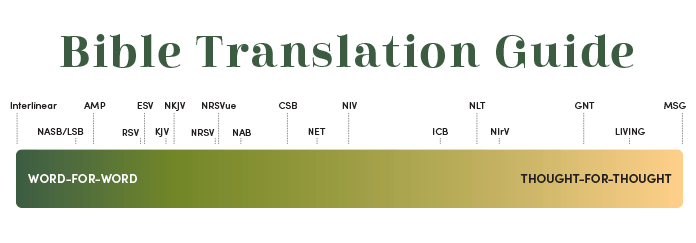
That is why Bible translations usually fall somewhere along a spectrum.
Word for Word
A word for word translation tries to stay as close as possible to the wording and structure of the original language.
Translations like the NASB and ESV lean in this direction. These can be especially helpful for deeper study because they allow you to see more of the structure of the Hebrew or Greek underneath the English.
The tradeoff is that they can sometimes sound a little more formal because Hebrew and Greek sentence structure does not always move naturally into English.
Balanced
Some translations intentionally try to sit in the middle.
They aim to preserve the wording of the original text while still making the English readable and natural.
The NIV and CSB is a good example of this approach.
These translations can be especially useful for everyday reading and study because they give strong attention to the original text while still being easy to follow.
Thought for Thought
A thought for thought translation focuses more heavily on communicating the meaning of a sentence or idea in natural English.
The NLT is a familiar example.
These translations can be especially helpful when a passage feels confusing or when you are trying to understand the flow of a larger section of Scripture. The translators are doing a little more interpretive work for you, which simply means it is helpful to know what kind of translation you are reading.
Paraphrase
A paraphrase is looser.
Instead of translating in the same way a formal translation committee would, a paraphrase restates biblical ideas in very modern language.
The Message is a familiar example.
A paraphrase can be helpful for hearing a passage with fresh ears, but I would use one as a companion rather than my main Bible for deeper study.
What About Reading Level?
Bible translations also differ in reading difficulty.
That is not a measure of faithfulness. It simply reflects vocabulary, sentence structure, and how naturally the translation reads in modern English.
The KJV is often placed around a 12th grade reading level, while the NASB is around 11th and the ESV around 10th. The NKJV and CSB fall closer to 7th grade, with the NIV around 7th to 8th. The NLT is often around a 6th grade level, and the NIrV is intentionally written at a much simpler level, around 3rd grade.
A lower reading level does not make a translation less spiritual or less meaningful. It usually just means the language is easier to process.
That can matter a lot if you are new to Scripture, reading with children, reading in a second language, or simply trying to understand a difficult passage.
So Which Translation Should I Use?
You do not need to choose one translation and defend it for the rest of your life.
For deeper study, I like having one Bible that stays fairly close to the original wording and another that is easier to read.
For example, you might study a passage in the NASB, then read it in the NLT to help you hear the flow more naturally.
That gives you both precision and clarity.
And if two translations sound a little different, you do not have to panic. Sometimes that difference is actually helpful because it slows you down and shows you where the original language may allow more than one reasonable way to express the same thought in English.
The goal is to understand Scripture more clearly.
So, Can I Trust My Bible?
This is where all of this history matters.
Christian faith does not ask us to pretend Scripture fell out of heaven already printed in English. The Bible came through real history, written by real people, copied by real scribes, preserved through communities of faith, translated by scholars, and carried across centuries.
There are manuscript questions, translation questions, and historical questions, and we are allowed to look at all of them. The more I study this, the more I appreciate that faith does not require us to avoid hard questions. We can examine the history of Scripture carefully and still trust the God who gave it.
You do not need to know every manuscript name or remember every date on the timeline. You do not need to become an expert in Greek or Hebrew before you can read your Bible with confidence.
You just need to know that the Bible in your hands did not arrive by accident.
It has been copied, carried, preserved, translated, printed, studied, and passed down through generations. The more we understand that story, the less mysterious Scripture becomes and the more confidently we can approach it.
And this is where it gets even deeper for me. We do have good historical reasons to trust how the Bible was preserved and passed down, but our confidence does not stop there. Christians believe Scripture is ultimately God’s Word. He used real people, with real personalities and writing styles, and still gave us exactly what He intended us to have. So when we say the Bible is trustworthy, we are really saying something about the character of God. He is truthful. He is faithful. And if He has spoken, then His Word carries His authority.
So if you are reading this between laundry, school pickup, work, dinner, and the dozen other things pulling at your attention, let this be your takeaway: you are allowed to ask questions about the Bible. You are allowed to learn how it came together. You are allowed to study beyond a devotional without needing to become a scholar.
That is exactly why The Study Room exists, to help us understand the faith we are building our lives on and to keep leading us back to Jesus.
Key Terms
| Term | What it means |
|---|---|
| Canon | The recognized collection of books that belong in the Bible. |
| Canonical | Describes a book that is recognized as part of the biblical canon. |
| God breathed | From 2 Timothy 3:16. Scripture comes from God, even though He used human authors to write it. |
| Hermeneutics | The principles and methods we use to interpret the Bible correctly. |
| Exegesis | Drawing the meaning out of the biblical text by asking what the author intended to communicate in its original context. |
| Covenant | A binding relationship established by God with His people, often involving promises, responsibilities, and signs. |
| Inspiration | The work of the Holy Spirit through the human authors of Scripture so they wrote what God intended. |
| Manuscript | A handwritten copy of a biblical text from the ancient world. |
Sources & Study Notes: This post was developed through personal Bible study and research using Scripture, the Rose Handbook of Bible Charts, Maps & Timelines, and publicly available information from Bible publishers and translation organizations. Historical dates, manuscript information, reading levels, and translation approaches were cross checked with additional reference sources for accuracy.
Wayne Grudem, Systematic Theology: An Introduction to Biblical Doctrine, 2nd ed., “The Authority of Scripture,” ch. 4 (Zondervan Academic, 2020), 62.


Leave a Reply