
Gratitude doesn’t start when life feels good… it starts when you choose to see the good.
No time to read? Listen instead…it’s the same heart, just spoken.
Philippians 1:3–5 (NIV)
“I thank my God every time I remember you. In all my prayers for all of you, I always pray with joy because of your partnership in the gospel from the first day until now.”
We love giving thanks when things are going well…when the house is clean, the kids are kind, the plans work out, and the sunsets are pretty.
But what about when everything feels off?
When people disappoint you.
When leadership fumbles.
When the vibe in the room feels… off?
Gratitude isn’t just for the obvious blessings. It’s a discipline. A lens. A posture that helps you see what God is doing even when the situation isn’t ideal.
Why Philippians?
If you’re wondering why we’re anchoring this Gratitude Reset in Philippians… it’s because this short letter is soaked in thanksgiving. And what makes it even more beautiful is that Paul wrote it from a prison cell.
Let that sink in: a dark, uncertain, confined space. And yet, the theme of joy shows up over and over. Not because Paul’s life was perfect, but because his perspective was anchored.
In the opening verses of Philippians, Paul says, “I thank my God every time I remember you…” (Phil 1:3). Even behind bars, he’s remembering people with gratitude. And it’s not just warm fuzzies. His gratitude is rooted in something deeper: their partnership in the gospel.
This is important: Paul isn’t being thankful for good vibes or sweet friendships. He’s thanking God for what He’s doing in and through the people…even in hardship. Gratitude, for Paul, is about alignment with what matters most. That’s the kind of thanksgiving that holds up when life doesn’t.
That’s the lens we’re aiming for this week.
The Lens You Look Through Matters
I’ve been learning this the hard way: we see what we’re looking for.
We see what we’re tuned to.
And most of the time, we’re walking around with a lens we didn’t even realize we picked up.
If I wear the lens of control, I’ll see chaos.
If I wear the lens of fear, I’ll see threats.
If I wear the lens of performance, I’ll see failure.
And if I wear the lens of criticism, I’ll see what’s wrong with everyone and everything.

That last one, criticism, is sneaky. It disguises itself as discernment or “just being honest,” but it robs me of compassion. It sharpens my eye and hardens my heart. It makes me more aware of others’ flaws than God’s presence. But if I ask God to trade that lens for grace…
I start to see light.
Because if I want to be the light, I’ve got to be able to see the light.
See the light when someone disappoints you.
See the light when leadership drops the ball.
See the light when it’s done completely differently than how I would’ve done it.
Not fake light. Not denial. But real light…evidence of God’s presence, even in uncomfortable or unfiltered places.

The Power of Naming the Good
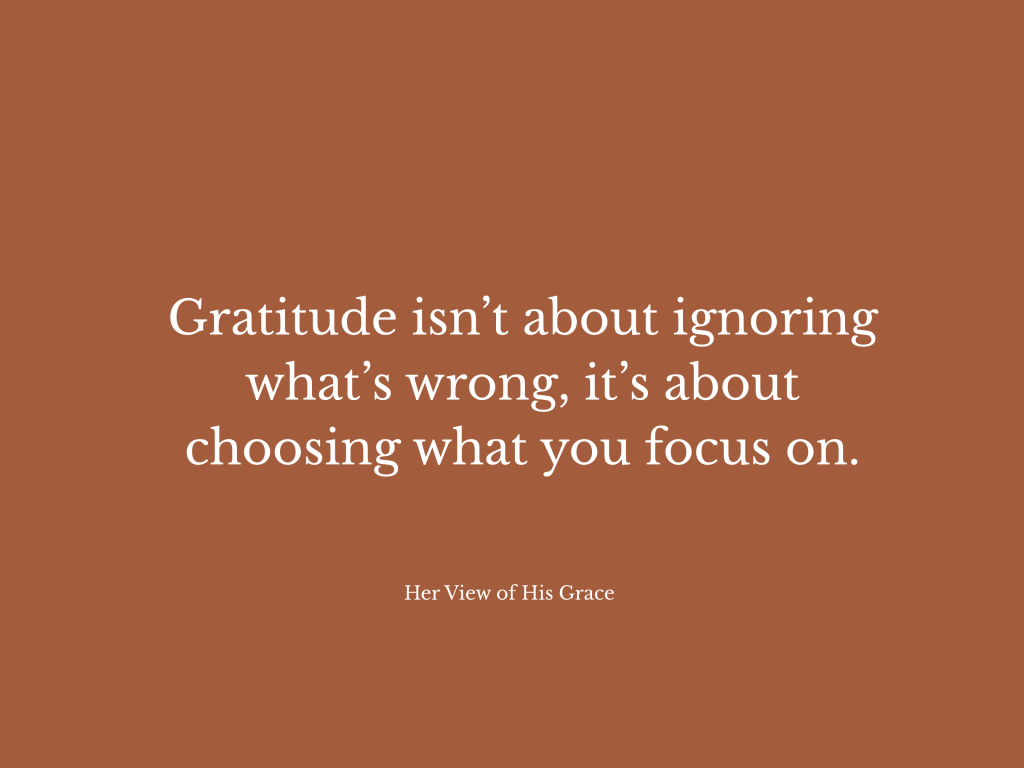
Here’s what I’m learning in real time: Naming the good is the best way to shift your lens. It’s not about ignoring what’s wrong or pretending things don’t bother you. It’s about choosing what you focus on, even in a messy moment.
Sometimes it sounds like this:
• “God doesn’t look at the outward appearance, He looks at the heart… maybe I should too.”
• “They tried their best.”
• “I don’t agree with how that was handled, but I’m thankful they showed up.”
• “They probably have a lot going on. Maybe I should pray for them instead of picking them apart.”
• “That wasn’t how I would’ve done it, but there’s still something good here.”
This is where 1 Thessalonians 5:16–18 backs us up:
“Rejoice always, pray continually, give thanks in all circumstances; for this is God’s will for you in Christ Jesus.”
Gratitude isn’t about turning off your discernment.
It’s about tuning it toward grace. It’s a choice to see what God is doing,
even in people or places that don’t feel easy to love. Gratitude in hard or ordinary places doesn’t start with a mood shift. It starts with a word shift…what you say to yourself in the moment. The deeper gift of gratitude is that it doesn’t just change the room, it changes what you see.
This week, start small. Name the good.
Not the highlight-reel good.
The ordinary, even here good.
- Where have I seen grace today, even in something that didn’t go as planned?
- Where did I feel a spark of peace, even when things were noisy or hard?
- What do I need to name with gratitude instead of critique?
Reset Step: Try the 3-for-1 Rule
When you catch yourself being critical, whether it slips out loud or stays quiet in your mind, don’t spiral in guilt. Just pause. And practice the 3-for-1 Rule.
For every one critical thing you said, thought, or muttered under your breath…
Name three good things in response.
Not to cancel out the wrong. But to retrain your perspective, to let grace speak louder than the complaint.
It might sound like:
• “That outfit was awful… I’m thankful she showed up, she’s bold, and God’s still working on both of us.”
• “He completely dropped the ball… but I’m grateful for the effort, the reminder to lead with humility, and that I can pray instead of pile on.”
One critical comment. Three grateful corrections. Let it realign your heart.
A Gentle Tool to Help

To help you carry this into real life, I created The Gratitude Reset Field Guide.
Inside, you’ll find printable tools like the 3-for-1 Rule Card: a simple way to retrain your thoughts when criticism creeps in. It’s pocket-sized, perfect for your mirror, journal, or dashboard… wherever you need a quick reset.
No guilt trip here. Just a gentle nudge to name the good when your flesh wants to name what’s wrong.
You can grab your copy of The Gratitude Reset Field Guide today… it’s free and designed to walk alongside this series.
Because sister… gratitude isn’t a way to fake it. It’s how we flip it.

And as we practice this again and again, my prayer is that the lens of grace becomes our default.
With grace,
Jessica Lee




 HER VIEW OF HIS GRACE
Leave a comment